
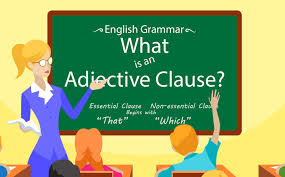
You’re probably already familiar withadjectives. They modify nouns and pronouns, providing a description or information.Adjective clauses, however, are groups of words that contain a subject and a verb, and provide further description.
Adjective clauses begin withrelative pronouns, including:
who
whom
whose
that
which
They may also begin with relative adverbs, such as:
when
where
why
Seems simple enough, right? Let’s dive right into some different examples of adjective clauses. As soon as you see adjective clauses in action, you’ll be able to spot them from a mile away.
Adjective Clauses in Action
Adjective clauses don’t usually change the basic meaning of a sentence. Rather, they clarify the writer’s intent.
Here’s one thing to keep an eye out for. When adjective clauses add more information to a sentence, rather than just description, they often need to be set off witha comma.
Here are some example sentences with the adjective clause underlined:
Pizza, which most people love, is not very healthy.
Those people whose names are on the list will go to camp.
Grandpa remembers the old days when there was no television.
Fruit that is grown organically is expensive.
Students who are intelligent get good grades.
Eco-friendly cars that run on electricity help the environment.
I know someone whose father served in World War II.
The slurping noise he makes is the main reason why Sue does not like to eat soup with her brother.
The kids who were called first will have the best chance of getting a seat.
I enjoy telling people about Janet Evanovich, whose latest book was fantastic.
The store where the new phone was being sold had a huge line of people outside it.
"He who can no longer pause to wonder and stand rapt in awe is as good as dead." - Albert Einstein
“Those who do not complain are never pitied.” - Jane Austen
“People demand freedom of speech to make up for the freedom of thought which they avoid.” - Søren Kierkegaard
“Never go to a doctor whose office plants have died.” - Erma Bombeck
Reducing Adjective Clauses to Phrases
An adjective clause that has a subject pronoun (which, that, or who) can also be shortened into anadjective phrase.
You can shorten an adjective clause in two ways:
Omit the subject pronoun and verb.
Omit the subject pronoun and change the verb so it ends in -ing.
Here are some examples to help you create an adjective phrase:
Adjective Clause: The booksthat were borrowed from classmust be returned.
Adjective Phrase: The booksborrowed from classmust be returned.
Adjective Clause: The girlwho is leading the paradeis my best friend.
Adjective Phrase: The girlleading the paradeis my best friend.
Adjective Clause: His share of the money,which consisted of $100,000, was given to him on Monday.
Adjective Phrase: His share of the money,consisting of $100,000, was given to him on Monday.
Adjective Clause: Somethingthat smells badmay be rotten.
Adjective Phrase: Somethingsmelling badmay be rotten.
Be Descriptive
Remember, the goal of an adjective clause is to add more information to a noun or a pronoun. As you can see from the examples above, you can add information by including a longer adjective clause or tighten up a sentence by turning the adjective clause into an adjective phrase.
Either way, thanks to these descriptive guys, you’ll be able to paint a more picturesque scene for your readers and help them fall into the story with enough description to make them feel like they’re a part of it.
No matter where your adjective clauses take you, always remember they travel well withcommas. More often than not, a comma is just the trick to set apart a non-essential adjective clause with elegance and grace.