

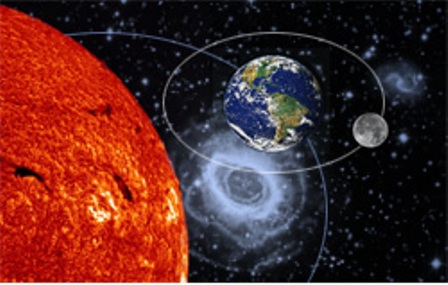
Earth is bigger than the Moon. Earth’s gravity pulls on the Moon. That is why the Moon orbits, or goes around, Earth. The SUN is bigger than Earth. Its gravity makes Earth go around the Sun. On a larger scale, gravity arranges cosmic bodies into orbits and even causes drifting space particles to pull together slowly into larger and larger clumps that eventually become planets, stars and galaxies.

Our weight depends on where we are because the pull of gravity gets less if we move further away from the center of the Earth. A man standing on top of a high mountain would weigh very slightly more if he came down to sea level. Other planets, smaller than the Earth, have a weaker gravitational pull, so we would weigh less on them. On a more massive planet we would weigh more, even though the mass of our bodies stays exactly the same as on Earth. Your weight on Earth is about six times more than it would be on the Moon, while on the planet Jupiter you would weigh about three times as much as you do on Earth.
Every time you jump, you experience gravity. It pulls you back down to the ground. Without gravity, you’d float off into the atmosphere- along with all of the other matter on Earth. In his “Principia” of 1687, Isaac Newton included his Theory of Universal Gravitation. It basically set forth the idea that gravity was a predictable force that acts on all matter in the universe, and is a function of both mass and distance. The theory states that each particle of matter attracts every other particle with a force that is directly proportional to the product of their masses and inversely proportional to the square of the distance between them.